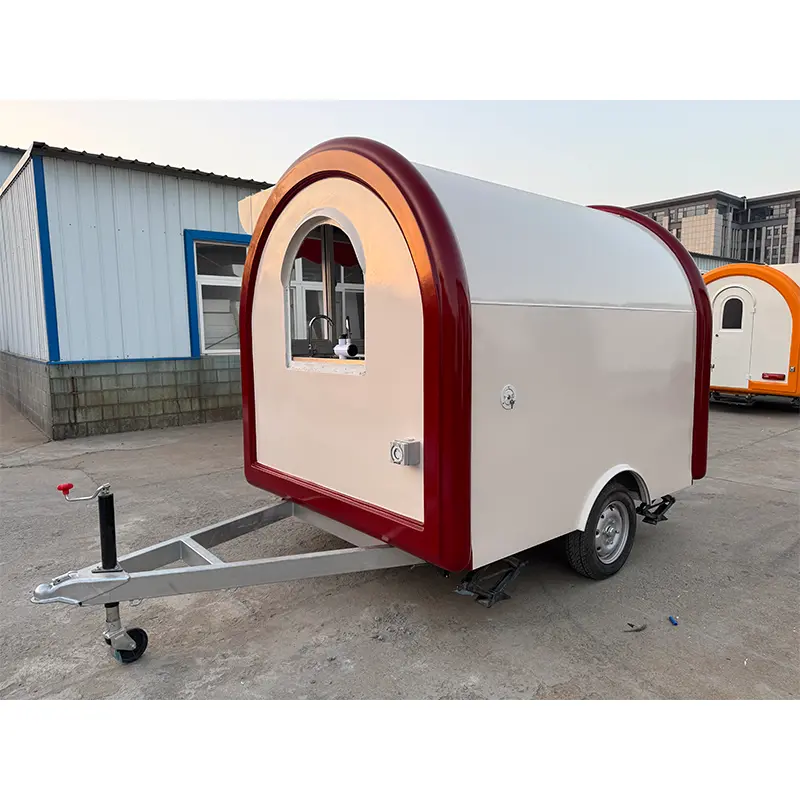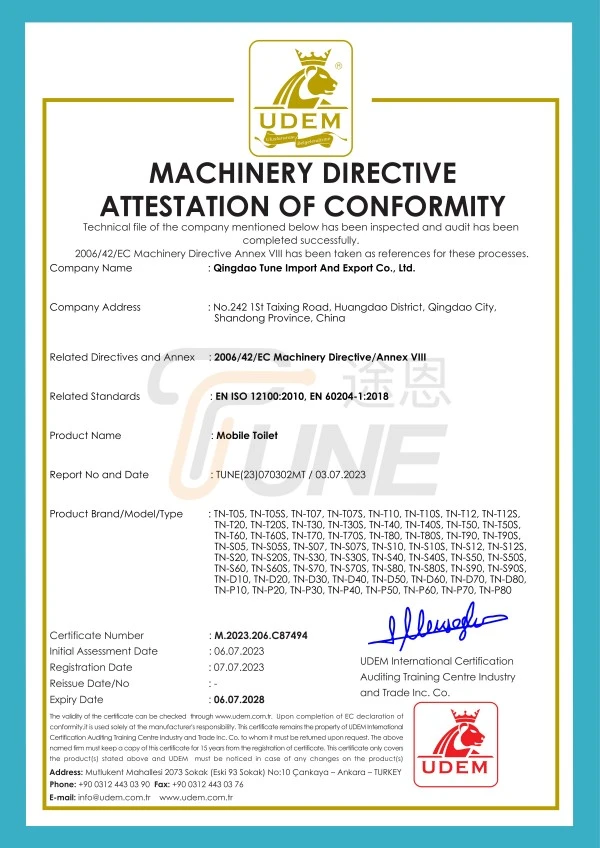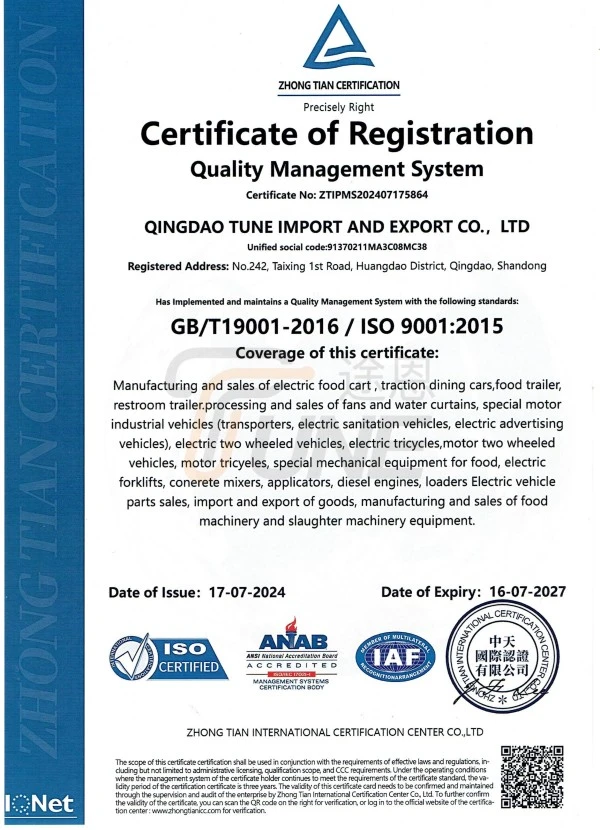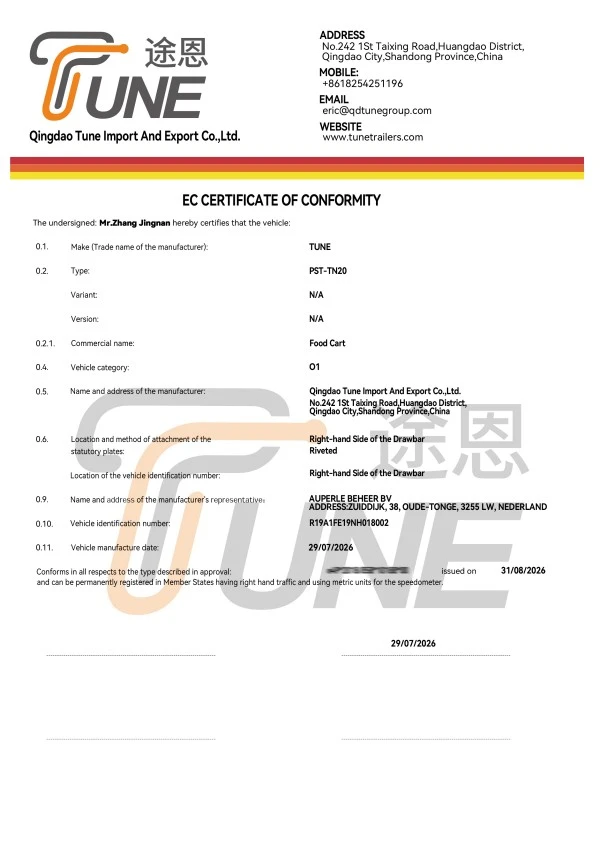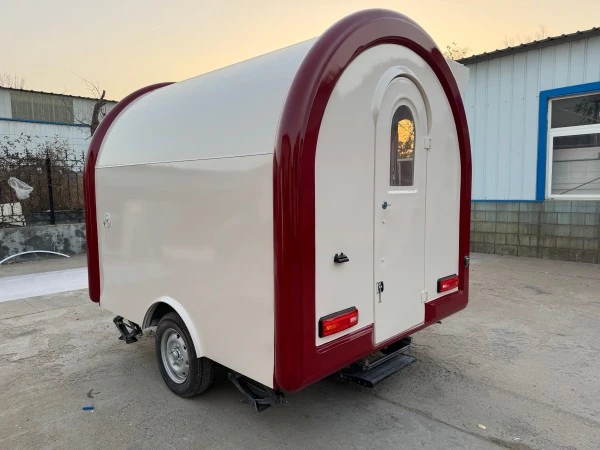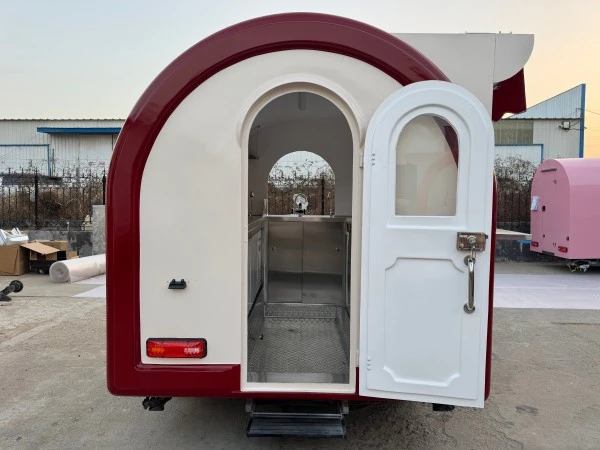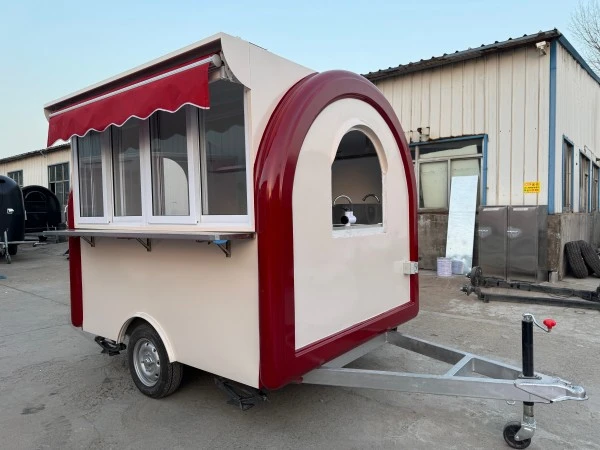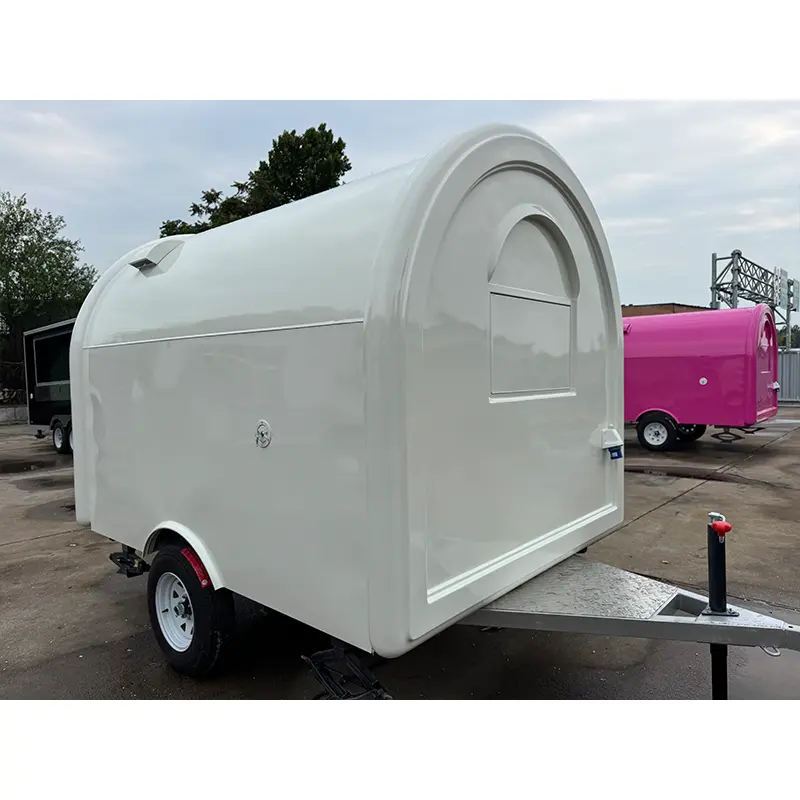
TUNE's compact mini round food trailer is a mobile operating space for small food businesses that need a maneuverable unit without the size of a full-scale catering truck. Its curved front profile and square-box body create a recognizable appearance, while the compact 3 m length supports use at farms, markets, roadside locations, festivals, food parks, and temporary catering sites. As a manufacturer of custom food trailers, TUNE supplies wholesale compact food trailers and mobile kitchen trailers to customers in North America, Europe, Australia, and other markets. The trailer is produced in TUNE's Qingdao factory under ISO 9001 quality management and can be supplied with CE and COC documentation for the completed unit.
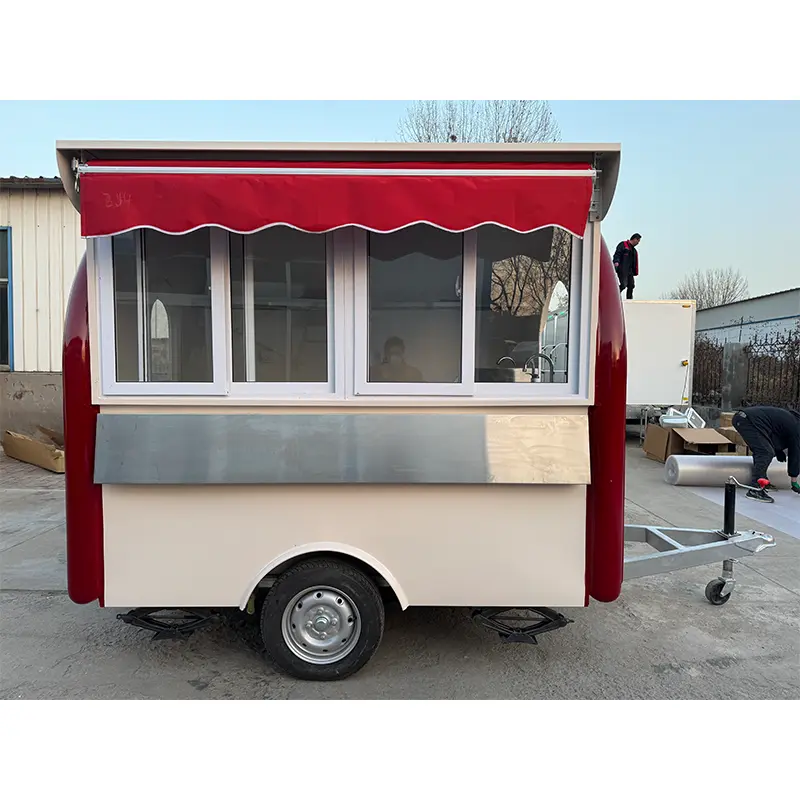
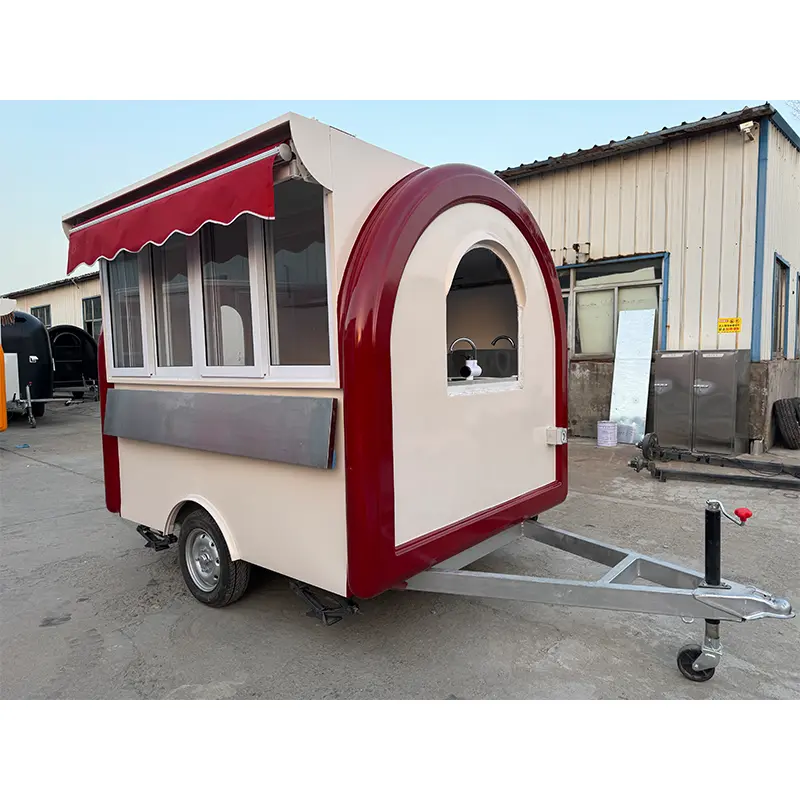
The exterior combines a light-colored body with a dark red rounded frame and matching awning. This color combination provides a clear visual identity for coffee shops, dessert brands, snack vendors, and event caterers. The serving window opens toward the customer side and can be used for order collection, product display, and direct handover.
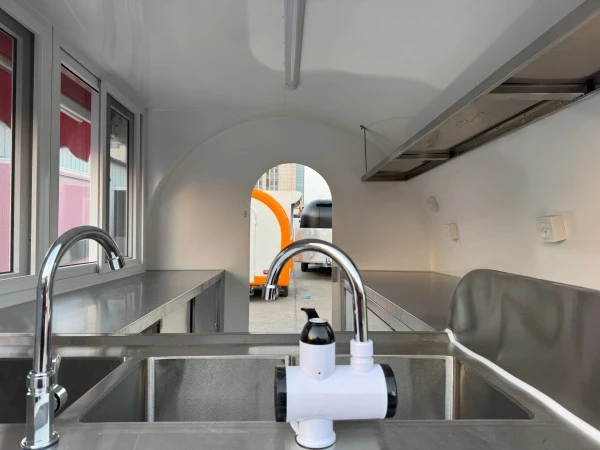
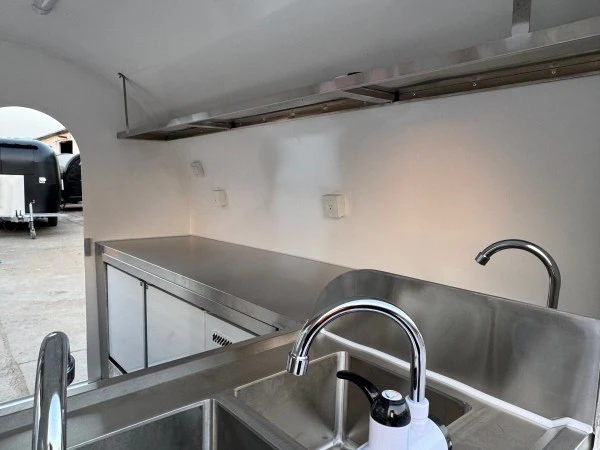
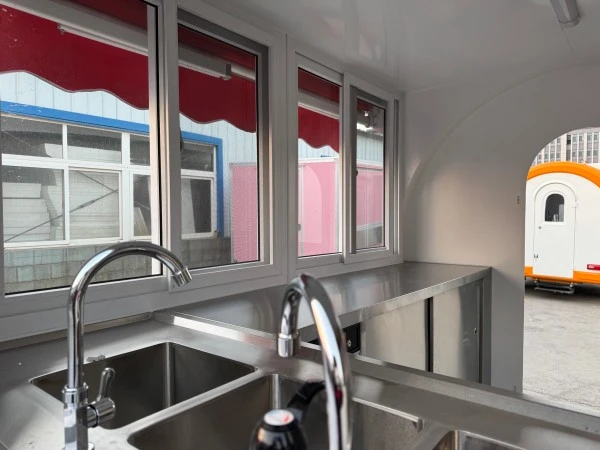
Inside, the trailer provides a continuous stainless-steel worktop, lower storage cabinets, overhead shelf space, a two-compartment sink, and multiple electrical outlets. The layout suits businesses that require a clean preparation surface and organized storage in a limited working area. This product is supplied as a food-service trailer rather than a complete operating business. Equipment such as a soft-serve machine, slicer, salamander, salad bar, or coffee machine should be confirmed separately according to the selected menu and power requirements.
TUNE manufactures this compact mini round food trailer under ISO 9001 quality management. CE and COC documents can be provided for the completed trailer and selected electrical system, based on the final configuration and destination market. Third-party inspection by SGS or Intertek can be arranged before shipment. Each trailer passes through a documented inspection process covering the chassis, body, worktops, sink system, electrical points, and towing components.


The curved front and raised red trim give this round food trailer a distinctive appearance compared with a conventional rectangular trailer. The exterior can be customized with a new color scheme, logo, text, menu board, or commercial graphics. A clear brand design helps customers identify the service point from a distance in busy outdoor locations.
The interior worktops run along both sides, creating separate areas for preparation, storage, and customer service. Lower cabinets can be used for cups, ingredients, utensils, packaging, and cleaning supplies. The overhead shelf provides additional space for lightweight items. For a coffee business, the counter may be arranged for an espresso machine, grinder, refrigerator, and cup storage. For ice cream or cold drinks, space can instead be reserved for a freezer, display cabinet, topping containers, and blender. Final equipment positioning should be decided before production because appliance size and weight affect the work sequence and towing balance.
The stainless-steel counters and sink areas are suitable for repeated cleaning when operated correctly. Smooth worktops make it easier to remove liquid, crumbs, and food residue after service. Corners, joints, cabinet edges, and drainage points should still be cleaned carefully because these are the areas where residue may accumulate.
The double sink supports a more organized washing and rinsing process. The water system can be configured with separate fresh-water and wastewater arrangements according to the buyer's operating location. Tank capacity, pump type, drainage outlet, and water-heating requirements should be listed clearly in the final quotation.
The trailer is intended for outdoor use and can be positioned at farms, fast-food sites, beverage shops, food festivals, parks, markets, and mobile catering locations. Before operation, the buyer should confirm ground conditions, access width, parking permission, electrical availability, local food-service rules, and trailer registration requirements.


|
Item |
Reference Specification |
|
Product Title |
Compact Mini Round Food Trailer |
|
Model Number |
TUNE-001 |
|
Brand |
TUNE |
|
Product Type |
Mobile food trailer / coffee shop cart |
|
Body Design |
Round shape with square-box body |
|
Main Material |
Steel / FDR / stainless steel |
|
Frame Material |
Stainless steel |
|
Reference Dimensions |
3,000 × 1,650 × 2,300 mm |
|
Reference Weight |
Approximately 750 kg |
|
Wheel Information |
3 wheels listed; final chassis drawing to confirm |
|
Axle Information |
Triple axle listed; final axle configuration to confirm |
|
Sanitation Facility |
Two-compartment sink |
|
Water System |
Double sinks |
|
Voltage Options |
110 V / 220 V / 240 V |
|
Power |
No fixed power rating listed |
|
Cooking Equipment |
Optional; steam table, soft-serve machine, slicer, salamander, salad bar and other equipment can be discussed |
|
Shelving |
Interior shelf storage |
|
Recommended Use |
Outdoor commercial service |
|
Applicable Industries |
Food and beverage factories, farms, restaurants, food shops and printing shops |
|
Color |
Customized |
|
Size Customization |
Supported |
|
Installation |
Easy assembly, subject to configuration |
|
Packaging |
Wooden case |
|
Place of Origin |
Shandong, China |
|
After-Sales Service |
Engineers available for overseas service |
|
Warranty / Quality Assurance Period |
One year |
The supplied specification contains both “3 wheels” and “triple axle” information. These two items should be technically reviewed before order confirmation because the final chassis design, wheel arrangement, axle rating, brake system, and permitted road load must correspond to the actual trailer. The confirmed production drawing should take priority over general listing information.
The mobile kitchen trailer can be used for several commercial concepts:
● Coffee and tea
● Ice cream and gelato
● Smoothies and cold drinks
● Sandwiches and fast food
● Salads and light meals
● Pastries and desserts
● Farm and agricultural-site catering
● Festival and market vending
● School or community events
● Hotel and resort food service
● Promotional product launches
A simple menu generally requires less equipment and allows more storage space. A menu involving cooking, refrigeration, and washing requires a more detailed layout review. Buyers should provide the expected menu, number of operators, service volume, appliance list, and preferred serving direction before customization.


Ingredient receiving → dry and cold storage → preparation → cooking or assembly → order collection → customer service → washing → waste handling → end-of-day cleaning
The two-sided counter arrangement allows the operator to divide the trailer into preparation and washing zones. Heavy machines should be installed low and as close as practical to the central frame. Lightweight packaging and dry goods may be stored on the upper shelf.
The service window should remain clear of unnecessary equipment so that staff can communicate with customers efficiently. If the trailer will be operated by two people, the worktop depth and walking clearance should be reviewed before the internal cabinets are fixed.
TUNE manages production through the following stages:
1. Confirm the product title, dimensions, and intended menu.
2. Review the chassis, wheel, and axle requirements.
3. Fabricate the stainless-steel support frame.
4. Form and install the curved exterior body.
5. Fit the service window, awning, and access door.
6. Produce the stainless-steel worktops and cabinets.
7. Install the double sink and water connections.
8. Prepare sockets and cable routes for the confirmed voltage.
9. Check interior shelves, edges, doors, and fixing points.
10. Complete dimensional and functional inspection.
11. Protect the body, windows, and hardware for wooden-case packing.
Inspection covers:
● Overall length, width and height
● Body alignment and frame fixing
● Exterior panel joints and curved edges
● Service-window opening and support hardware
● Awning operation and locking points
● Stainless-steel worktop flatness
● Sink sealing and drainage
● Cabinet-door operation
● Shelf load support
● Wheel, coupling and support-leg condition
● Lighting, brakes and electrical connections where installed
● Packing stability during transport
Before towing, inspect the coupling, safety chains, tires, wheel fasteners, lights, brakes, jockey wheel, and support legs. All loose kitchen equipment, bottles, containers, and small appliances should be secured before movement.
At the operating site:
● Park on firm and reasonably level ground.
● Use the support equipment before entering or serving from the trailer.
● Keep heavy appliances low and evenly distributed.
● Avoid exceeding the confirmed permitted load.
● Keep electrical sockets away from direct water splash.
● Clean worktops and sinks after every service period.
● Empty wastewater according to local environmental rules.
● Dry stainless-steel surfaces after washing.
● Check hinges, cabinet locks, seals, awning supports, and wheel hardware regularly.
● Use qualified technicians for electrical, gas, refrigeration, and cooking-equipment work.
If hot equipment is added, the trailer may require ventilation, heat protection, fire extinguishers, and additional clearance. These requirements should be assessed before installation rather than after delivery.
The required approvals depend on the destination country and final configuration. Buyers should check:
● Trailer registration and roadworthiness
● Axle, wheel and braking compliance
● Lighting and reflective markings
● Coupling and safety-chain requirements
● Electrical voltage, grounding and circuit protection
● Food-contact surface requirements
● Fresh-water and wastewater handling
● Gas equipment and pressure regulation
● Ventilation and fire prevention
● Outdoor vending permission
● Local food-business licensing
TUNE can provide technical details for the confirmed order configuration. Any certificate, inspection report, or compliance document should match the actual body, chassis, appliances, and destination market. General product information should not be treated as a substitute for local approval.
Yes. TUNE supports customized length, width, height, worktop layout, serving-window position, cabinet arrangement, color, and branding. Any dimensional change should be checked against towing capacity, axle load, site access, and local road restrictions.
The specification lists several possible cooking-equipment options, but it does not mean that every appliance is included as standard. The buyer should confirm the exact equipment list, brand, model, voltage, power, and installation position in writing.
Yes. It can be arranged for coffee service with an espresso machine, grinder, refrigerator, cup storage, sink, and POS area. The final power demand should be calculated from the selected appliances.
Yes. A freezer, display cabinet, topping station, and cleaning area can be incorporated. Refrigeration equipment should have sufficient ventilation clearance and a suitable electrical supply.
The product includes a towing structure, but the final road suitability depends on the completed chassis, wheel arrangement, axle rating, brake system, coupling, and destination-country regulations. These details should be confirmed before shipment.
TUNE can provide CE and COC documents for the completed trailer and selected electrical system, based on the final configuration and destination market. ISO 9001 applies to the manufacturing process. Third-party inspection by SGS or Intertek can be arranged.
The warranty or quality-assurance period is one year under the agreed purchase terms. The contract should define the covered body structure, hardware, water system, electrical components, and optional equipment.
TUNE can provide technical communication, configuration confirmation, installation guidance, and after-sales coordination. Engineers are listed as available for overseas service, subject to the agreed service scope and destination.
The purchase agreement should record the final dimensions, body materials, chassis specification, wheel and axle configuration, rated load, braking system, coupling, sink and water system, voltage, equipment list, exterior finish, packaging method, inspection standard, shipping scope, and one-year warranty terms.
For buyers purchasing a custom food trailer, a pre-shipment checklist can reduce misunderstandings. The inspection should verify dimensions, opening functions, cabinet access, sink drainage, electrical points, towing components, surface finish, and packing condition. TUNE can also assist with replacement-part identification when the buyer provides the model number and component details.
This small round concession trailer is most practical when the design is planned around the actual menu and operating site. Confirming equipment weight, staff numbers, customer flow, cleaning procedures, and local compliance requirements before fabrication helps create a safer and more efficient mobile food-service workspace.
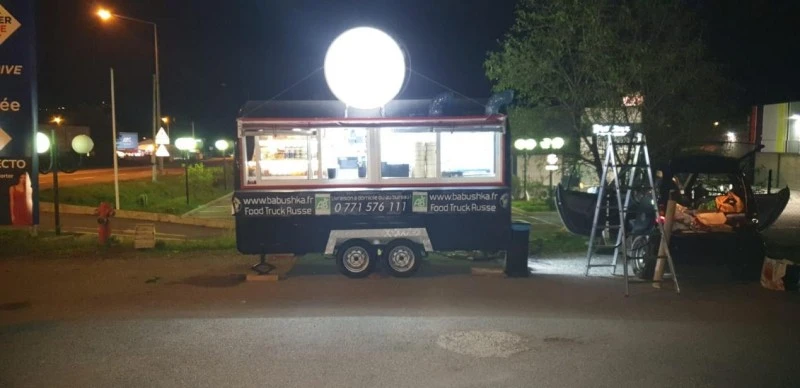
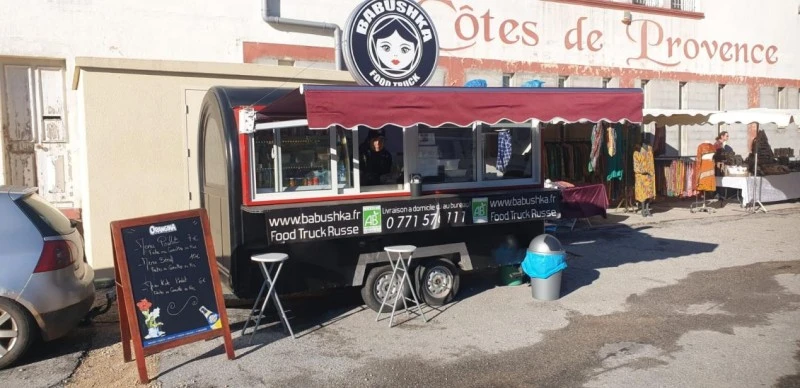
● Product Model: Compact Mini Round Food Trailer (Dual-Axle Aerodynamic Series)
● Operating Location: Provence-Alpes-Côte d’Azur Region, Southern France
● Cuisine & Concept: Traditional Eastern European & Russian Gourmet Street Food (Babushka Food Truck Russe)
● Key Exterior Features: Matte Black & Crimson Frame, Dual Axle Assembly, Retractable Red Fabric Awning, Top-Mounted Circular Illuminated Marquee Sign
Operating a mobile food business across French towns and roadside markets involves specific electrical, structural, and towing standard compliance:
Navigating roundabouts and narrow municipal streets in Southern France requires a steady chassis setup. The dual-axle configuration with independent suspension and corner leveling jacks provides smooth towing behind standard passenger vehicles and balanced parking on uneven gravel parking lots or town squares.
● Daytime Heat Protection: Integrated with a heavy-duty retractable red canvas awning, creating shade for queuing customers during hot Mediterranean summer afternoons.
● Nighttime Visibility: Equipped with a top-mounted circular backlight sign unit, ensuring the vendor remains clearly visible to passing traffic during evening roadside dinner service.
Serving multi-item hot meal menus (Menu Poulet, Menu Bœuf) requires steady electrical output. The internal compartment is pre-wired with French standard (230V) sockets, independent circuit breakers, and top ventilation ducting to run electric food warmers, counter displays, and beverage chillers simultaneously.
Verified Reviewer: Commercial Catering Operator
Operating Area: France (Provencal Towns & Event Markets)
Overall Rating: 5.0 / 5.0 Stars
"We purchased the Compact Mini Round Food Trailer from TUNE to launch our authentic food truck concept in France. Our operation shifts between daytime open-air markets and evening roadside locations, so we needed a trailer that was compact, easy to set up, and visually distinctive.
The ocean freight shipping to France was handled efficiently. The trailer arrived fully intact with all exterior paintwork, roof sign wiring, and internal stainless steel counters meeting the specs we agreed on during production.
In everyday use, the dual axle makes towing very balanced even when fully loaded with ingredient stock and beverages. The wide front service window and extended red awning are great for serving customers comfortably under rain or shine.
Inside, the 304 stainless steel wall panels and counters are easy to wipe down between shifts, and the electrical system handles our daily equipment load without any power trips. It is a well-built, reliable mobile catering trailer that meets our daily operational needs in France."

Address
1711, Building B, Hisense Lingshan International, Yingzhu Sub-District, Huangdao District, Qingdao City, Shandong Province, China